
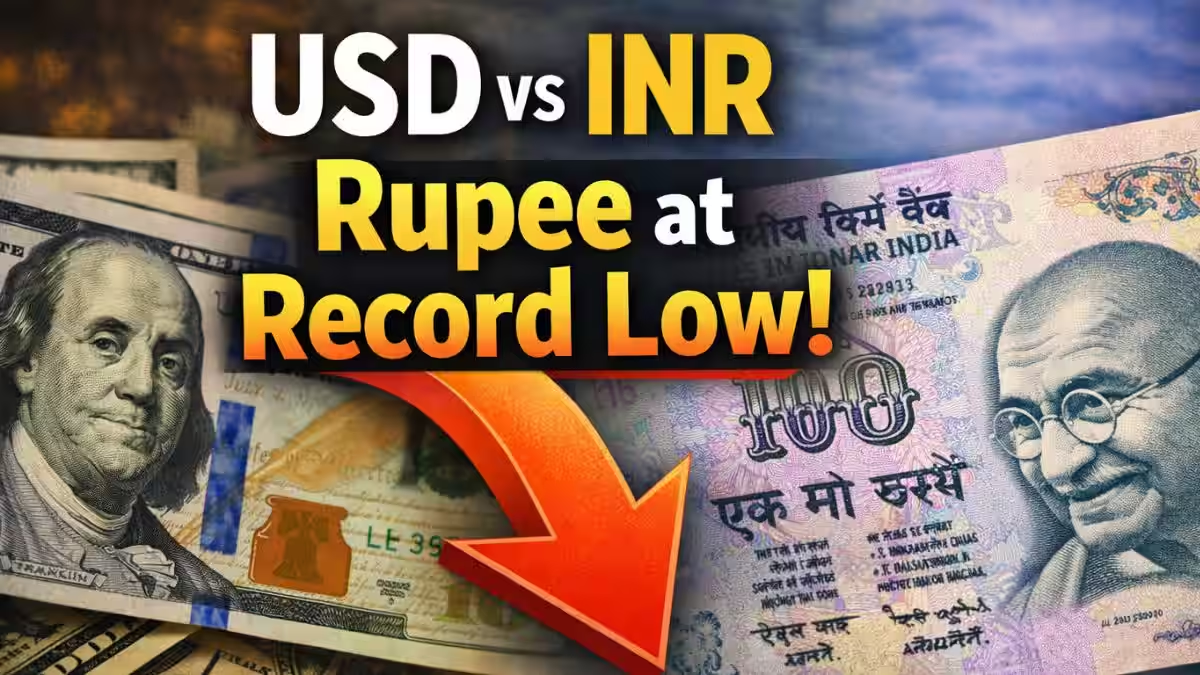
The Indian economy is experiencing healthy growth rates, India has a massive market, and the global power of India continues to grow steadily. But the country has received a wake-up call in terms of its foreign exchange rate.
The rupee is facing a new round of pressure from the currency markets due to high oil prices, capital outflows, inflationary expectations, and foreign policy. According to the reports of Indian financial sources, the Indian currency reached a historic low of 95.63 against the U.S. dollar during Tuesday due to the rise in crude oil prices and political instability.

Indeed, depreciation of the rupee affects various aspects of life in the country and the economy. It leads to increased costs of imports, including fuel costs; the growth of the trade deficit; difficulties for companies with foreign borrowing; and the Reserve Bank of India’s inability to implement an effective monetary policy to maintain a healthy inflation level. For a country that relies heavily on importing crude oil, the situation becomes rather difficult.
India’s economy is currently far from crisis situations. However, it is clear that certain problems have arisen that require special attention from the authorities.
The Fall of the Indian Rupee Concerns More Than Just the Dollar
As can be understood from the reports of Indian media, the latest fall in the rupee value occurred not suddenly but rather gradually. As Business Standard writes, the rupee continued to show fresh historical lows due to growing oil prices, persistent foreign outflows, and inflation concerns. In addition, dealers note that there were indications of intervention by the RBI through the activities of state-owned banks before 95.50-per-dollar.
Such an approach to intervention demonstrates the ability of India’s central bank to regulate currency volatility by allowing certain fluctuations.
Also, the decline in rupee value has affected other major world currencies. This can be concluded, in particular, from the information published by The Economic Times, reporting a fall in the value of the Indian currency against such majors as the Australian dollar.
In this context, it becomes clear that the issue goes beyond the dollar rate only.
From all reports, the immediate reason for the collapse of the rupee’s dollar exchange rate is the increase in oil prices amid geopolitical uncertainty. Mint reports that the collapse of rupee value was caused by rising oil prices amid geopolitical risks. At the same time, according to Moneycontrol, the collapse of rupee value can be associated with growing tensions in the international market.
This situation is especially problematic for India because of the following reasons:
the high level of dependence of this country’s economy on oil;
high level of oil prices;
capital outflows related to the operations of foreign investors;
falling rupee value.
Therefore, it turns out that for India, the problem of oil is especially acute because of the negative consequences it brings for the domestic economy.
In turn, the rupee’s record low is also a critical event not only for India but also globally since it reflects the vulnerability of India to external risks. This topic requires special attention from both economists and foreign investors interested in investments in emerging markets.
After reaching a new historic low, there is now talk in the Indian financial market about the rupee touching another significant psychological border: 100 per dollar. Indeed, according to Mint, it seems that now there can be talks about the possibility of reaching 100 per dollar level
Round values have always attracted the attention of financial analysts. As soon as this level is discussed, there is a rush among importers to hedge against future risks, and global investors begin to reconsider their positions regarding investing in India.
All this leads to a vicious circle of pressure on the currency.
The RBI Has Limited Tools for Intervention
Given the complex macroeconomic environment in India, the Reserve Bank of India faces a difficult task of intervention in the forex market. Too aggressive actions could deplete foreign exchange reserves or tighten the monetary conditions. But on the contrary, the absence of measures could increase inflation expectations and make investors pessimistic about further development prospects of the Indian economy.
Thus, as Economic Times notes, traders are confident that the RBI sold dollars in order to defend the position of the rupee when the exchange rate approached 94.9650 per dollar. Business Standard mentions that the historic low of rupee against dollar could cause a change in monetary policy since recently the RBI reduced interest rates by 125 basis points under Governor Sanjay Malhotra.
In this case, the main challenge is to find a balance between stimulating economic growth and protecting the domestic currency from excessive devaluation.
In general, former RBI governor Duvvuri Subbarao recommends stopping excessive intervention of the central bank and allowing the rupee to reach a low enough level in order to signal a true price in the currency market, according to Business Standard.
Of course, it would be quite difficult from the political point of view.
The Outflow of Foreign Investors Exacerbates the Problem
It is known that foreign portfolio investors tend to sell securities when withdrawing foreign investments from the market and thereby increase pressure on the currency.
This can be seen from Goldman Sachs report cited by The Economic Times, according to which the outflow of foreign institutional investors reached a historic figure of $22 billion in 2026 and one of the biggest in recent years. Moreover, it turns out that, despite the attractiveness of India’s primary stock market, the outflows of FIIs persist in equities.
Apparently, foreign investors trust selective investments in the IPOs and shares of companies with growth potential. However, they prefer to avoid broader market investments with a falling rupee, rising oil prices, and political tensions.
Why the Indian rupee’s record low could lead to problems for local stocks? On the one hand, this will positively affect the export-oriented industries; for example, IT services. On the other hand, many companies in other industries, especially those focused on imports, will be negatively affected.

Investors analyze all this very carefully today.
India Has Powerful Prospects but Is Vulnerable
The rupee’s fall, despite the fact that India continues to grow healthily, is evidence that the country still remains vulnerable to external risks. The fact is that despite positive macroeconomic trends, India remains subject to pressure from other global factors, such as the strong dollar, higher oil prices, capital outflows, and geopolitical risks. The only difference is that India became a country of global importance; therefore, any movements of rupee cause concern in the forex markets.
However, this is the problem that policymakers should solve now in order to achieve sustainable economic growth and maintain stability.
Sources
- Mint: Rupee slips 19 paise to hit record low of 95.50 against US dollar; will it touch 100?
- Business Standard: Rupee hits fresh low amid crude oil and FPI pressure
- Economic Times: Not just US dollar, Indian rupee has tanked across major currencies
- Economic Times: RBI likely selling dollars to limit rupee’s fall, traders say
- Business Standard: Record-low rupee may end India’s cheap-money era and force RBI policy shift
- Business Standard: RBI should dial back rupee intervention, says former governor Subbarao
- Economic Times: Rupee record fall explained: What’s weighing the currency and where is it headed?
- Mint: Rupee rebounds after RBI’s sweeping forex curbs, but outlook hinges on global cues
[…] India Rupee Record Low Shakes Markets – Terrene Globe […]
[…] India Rupee Record Low Shakes MarketsNew Report on the Egypt Suez Canal Crisis […]
Comments are closed.